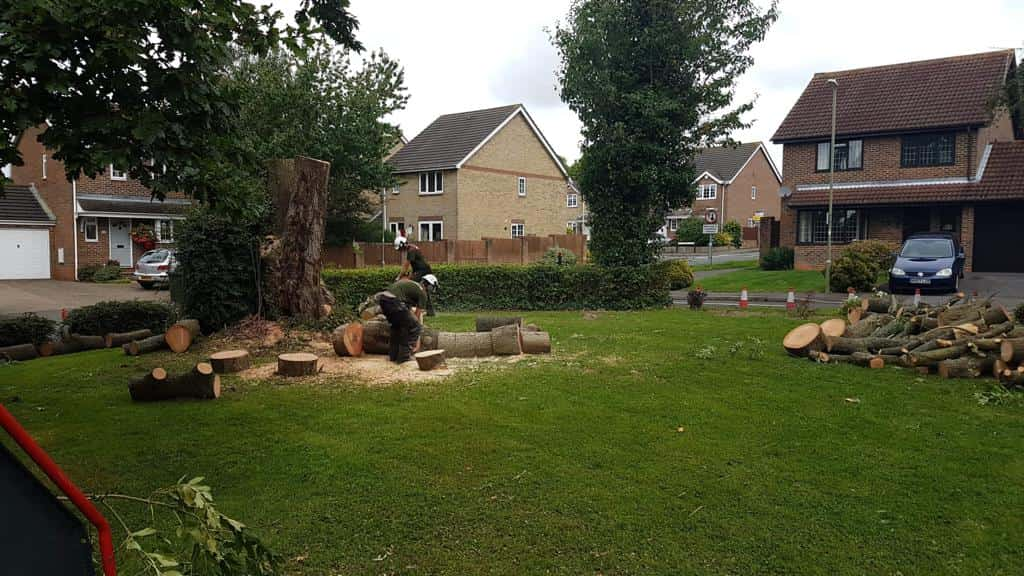
Severe weather can place considerable strain on trees, particularly when strong winds and persistent rain affect branches, trunks and surrounding soil. A tree that previously appeared stable may develop broken limbs, a weakened crown or movement around its roots.
For property owners in Hedge End, Hampshire, recognising potential damage and responding carefully can help prevent an unstable tree from becoming a more serious problem. Because defects are not always obvious from ground level, professional assessment is often the safest way to establish what work is required.
How to Respond to a Storm-Damaged or Dangerous Tree
The first priority is to keep people away from the affected area. Do not stand beneath damaged branches or attempt to move large sections of fallen timber. A branch that appears securely caught within the crown can shift unexpectedly, while a partially uprooted tree may continue moving after the weather has passed.
Where possible, prevent access to the immediate area and contact a professional tree surgeon. The tree should be assessed before decisions are made about pruning, dismantling or felling.
Look for Clear Signs of Storm Damage
Some forms of damage are immediately visible. Others can be concealed within a dense crown or on the side of the tree facing away from the property.
Warning signs can include:
- broken or hanging branches
- fresh cracks in the trunk or major limbs
- branches resting against buildings or other trees
- a newly leaning trunk
- exposed or lifted roots
- disturbed or raised soil around the base
- sections of the crown that appear uneven
- creaking, splitting or unusual movement
Even if a damaged branch has not fallen, it may no longer have sufficient structural support. A professional inspection can determine whether it should be removed and whether the rest of the tree remains stable.
Do Not Assume the Tree Is Safe Because It Is Still Standing
A tree does not need to fall completely to become dangerous. Severe weather can weaken important branch unions, split internal fibres or destabilise the root plate without causing immediate collapse.
Damage may become apparent later, particularly when the tree moves during another period of wind. Rain-soaked ground can also reduce root stability, increasing the significance of a new lean or movement at the base.
If the tree looks different after severe weather, it is sensible to have that change investigated rather than waiting for further deterioration.
Avoid Attempting Major Tree Work Yourself
Storm-damaged trees can behave unpredictably. Split branches may be carrying considerable tension, and cutting them in the wrong place can cause sudden movement. Fallen trees can also remain supported by neighbouring branches, fencing or structures.
Chainsaws, ladders and improvised access equipment should not be used to tackle large or suspended branches. Professional tree surgeons have the equipment and experience required to evaluate load, movement and safe working positions before making controlled cuts.
A Professional Assessment Identifies the Full Extent of Damage
The most obvious broken branch may not be the only problem. A proper assessment should consider the whole tree, including:
- the condition of the trunk
- cracks around major branch unions
- the balance of the remaining crown
- root and soil movement
- previous decay or cavities
- damage caused by falling limbs
- the tree’s proximity to buildings and access routes
This allows the work to address the underlying issue rather than simply removing visible debris. It may also reveal that the tree can be retained through selective pruning rather than removed entirely.
Can a Storm-Damaged Tree Be Saved?
Many damaged trees can be retained if the trunk and root system remain stable. The appropriate response may involve removing broken branches, reducing excessive weight or reshaping an unbalanced crown.
The decision depends on the tree’s species, maturity, condition and the severity of the damage. A tree with one damaged limb may respond well to targeted pruning, while extensive splitting or major root movement may require sectional dismantling or felling.
The objective should be to retain a healthy tree where practical without overlooking structural defects that could continue to worsen.
Why Prompt Attention Matters
A cracked or partially detached branch can deteriorate under its own weight. Damage to the crown may also leave the tree unbalanced, placing additional strain on the remaining limbs and trunk.
Prompt assessment can help:
- remove hanging or fractured branches
- restore suitable clearance around buildings and paths
- reduce excessive loading on weakened sections
- determine whether the roots remain stable
- prevent avoidable secondary damage
- establish whether ongoing monitoring is appropriate
Early attention also makes it easier to plan the work carefully before another period of severe weather affects the tree.
Check Surrounding Trees as Well
Severe weather may affect several trees within the same property, even when only one has suffered obvious damage. Trees of similar size and exposure may have loose branches, cracked unions or root movement that is difficult to identify from the ground.
A wider inspection can be particularly valuable where trees stand beside driveways, gardens, entrances or regularly used outdoor areas. This provides a clearer understanding of the condition of the entire site rather than focusing solely on the most visible failure.
Conclusion
If a tree becomes dangerous after severe weather, keep people away from it and avoid attempting major cutting yourself. Hanging branches, trunk cracks, a new lean and movement around the roots are all signs that professional assessment may be needed.
Not every damaged tree requires removal. Timely pruning, crown management or controlled branch removal may allow it to remain safely in place. Where the damage is extensive, a carefully planned dismantling may be the most appropriate solution.
If you are concerned about a storm-damaged tree in Hedge End, Hampshire, LM Tree Surgery Hedge End can assess its condition and recommend a suitable course of action. Contact the team to arrange a professional inspection and practical advice based on the tree’s actual condition.
Call us on: 01489 359 998
Click here to find out more about LM Tree Surgery Hedge End
Click here to complete our contact form and see how we can help with your tree needs.